
4 years in the making, 8,000 sites, unprofitable business and a technology that may change the future.
I have not been very vocal about PanelAlpha for quite some time but I think it's time for a genuine summary of how we have been doing. On one hand, I'd like to be honest about what we have achieved with this project so far: after 4 years, we now have around 8,000 active sites managed by around 60 partners (no, it's not a great success to brag about). However, it seems that we might be onto something with PanelAlpha Engine, our core back-end technology, which we created as an experiment around two years ago. And we've been preparing to pivot and expand PanelAlpha into a new market that is now emerging.

How PanelAlpha started
When we looked at the web hosting market in 2021, we were seeing more and more requests from customers (mostly at ModulesGarden) that there was a need for better WordPress management for end users. Managed WordPress was not new at that time as well as platforms focused strictly on WordPress. But looking at the traditional hosting market as a whole, it really seemed that there was a need to significantly simplify WordPress management for their end-users. Some hosting companies were reporting that even 80% of their customers were using WordPress, while at the same time they were offering clunky interfaces and legacy control panels.
Naturally, I came to a conclusion: we have access to hosting companies and relationships with them. Let’s create a panel simplifying WordPress management for non-technical users, with SIMPLICITY as the core value.
That’s how PanelAlpha was born.
So, a simple panel means a simple project and fast execution? Not even close… the project turned out to be extremely complex! Most hosting providers, despite offering relatively similar products, have very different workflows, infrastructure, technologies and integration requirements. We released our BETA in late 2023, version 1.0 on March 14, 2024, and then for the next two years we were mostly catching up with missing features and integrations (which every company saw differently).
Bad product market fit?
Sounds like a great plan, so why didn’t PanelAlpha get more popular?
Well, there were a few reasons, but being personally close to the onboarding process of our customers, I truly believe it was mostly because… our clients (the hosting providers) were not fast enough at execution.
What do I mean? The large companies that understand the problem already have their own platforms, build and maintain them for themselves and, most importantly, put huge marketing behind those products. Smaller companies that could offer services based on PanelAlpha naturally have fewer resources and less knowledge about how to offer such a product in their market, for example, in their local country.
For this model to work our client:
- needs to learn a new technology, introduce the product to their team and integrate it with their systems, billing and so on
- (most likely) create a new product line, because converting shared hosting into WordPress hosting is not that easy (not everyone uses WordPress)
- needs to prepare and execute a solid marketing campaign
We even discussed this topic in my podcast with Artur Grabowski from Extendify, using WordPress as an example. WordPress itself does not really take care of the distribution of its technology. In theory, this sounds great. Access to hundreds of thousands of customers through a few dozen partners. In reality, if a hosting provider does not execute the distribution well, the product does not grow.
This is a classic problem in the industry and is very obvious to me now: hosting providers usually just DON’T execute fast. I even wrote an article about why the web hosting industry is so slow to change, but that was something I learned much later after working with PanelAlpha.
And to be clear, not every company we worked with is bad at execution. A significant number of our customers are agencies, for example, and they don’t even plan to scale to thousands of sites so things go faster for them. We are still onboarding more customers so sooner or later this model will work.
Still, it’s hard not to feel that the time and money could be used better :)
The decision to go directly to users
Once the product matured, another thought naturally came up: If offering our panel through hosting providers scales slowly, why not offer our solution directly to end users, just like other control panels do?
We were focused on simplified WordPress management, automation and performance, where other solutions were not even close. So this could be a perfect offer for anyone who wanted to take control of their own WordPress hosting and get what many managed providers offer, at a much lower price.
From a business perspective, this was definitely the missing piece of the puzzle. Because if we are able to target end users directly ourselves, we can find many more traction channels for our product and stop being dependent on hosting companies. At the same time, if we show hosting companies that something like this can actually be built and sold, they should be more eager to implement it themselves.
That’s how PanelAlpha Single Server Edition was born.
The BETA came out on March 19, 2026 and we already had a plan back in February to eventually release it as an expanded offering together with PanelAlpha 2.0.
PanelAlpha Engine started as an experiment
When we originally started developing PanelAlpha, it was a front-end panel built on top of other control panels. The main difference and the key idea behind PanelAlpha was, as I mentioned before, to create the simplest possible panel for non-technical users to manage WordPress. In this model the backend was supposed to rely on integrations with popular control panels and other solutions. PanelALpha would connect everything together, simplify it for users and give hosting providers a new level of self-service for their customers.
But we kept hearing more and more that cPanel/Plesk/DirectAdmin + PanelAlpha was expensive and people kept asking why we wouldn’t create our own backend technology.
So we started experimental work on our own backend engine and called it PanelAlpha Engine. It was supposed to be as simple and secure as possible and integrate directly with our panel. We went with Docker mainly because of the natural isolation between users, but also because of the great performance, which beat popular control panels by even 20x in our initial tests.The downside was that Docker doesn’t really allow overselling, which is a standard practice in mass hosting. A server would ultimately host even 2-3x fewer accounts than with a traditional control panel. On the other hand, the high performance was a perfect fit for managed service providers that charge more but also offer better quality, and it allowed them to offer a higher quality service to their customers.
Anyway, it was an experiment. We released it as a BETA together with the early production version of PanelAlpha in 2024 and… something happened that we did not expect. After the first few months, more than 60% of our customers were using PanelAlpha Engine instead of traditional control panels. Not just that, but they were even using it in production despite our warnings and reminders that it was still a beta!
That was a clear signal that we should keep developing it. So finally, after a long series of fixes and improvements, on October 15, 2025 we released Engine v1.0 as production-ready.
We didn’t know yet that PanelAlpha Engine as a technology could open opportunities that we hadn’t even seen yet…
The market changed
When AI coding first started getting attention, a lot of people were skeptical about the idea that “anyone can just create their own project”. Who is going to maintain it? What about security? Good luck with updates and developing that spaghetti code!
But over time, more and more people started discovering new tools, especially Codex and Claude Code, and I think that around Q1/Q2 2026 it was already clear to almst everybody: This is not a toy anymore. People are creating amazing things at an unprecendented scale and we are entering a new era of software creation. There were also very clear signals that more and more individuals, but also agencies, were already building projects differently and WordPress stopped being the simplest way to launch a website or a portal.
On one side, we have the crazy growth of vibe-coding tools like Lovable. At the same time, Astro, Node.js and similar technologies are becoming more popular. On top of that, the open-source market is going through a renaissance. There is hardly a week without a new open-source alternative to some popular SaaS coming out.
But most importantly: a new hosting user was born. People who had never programmed before because it was too time-consuming or complicated started creating huge numbers of projects on a scale we had never seen before. Most of them are tools for their own use. Some people try to commercialize the, others use them inside their companies.
But this user, by nature, is neither a developer nor a DevOps engineer. You could call them an “AI Builder” (I’ve also seen AI Engineer or simply just Vibe Coder)
And this is where the problem appears: Creating is easy. But hosting it, especially on your own server, is not. Looking at the competition, that products in this category are very often created by technical people and targeted at developers or syadmins. A huge number of less technical users are simply being ignored!
Wait, I have my own simple panel for it!
After the last CloudFest EU, full of inspiration and excitement, I was working on another vibe-coded project with my Claude.
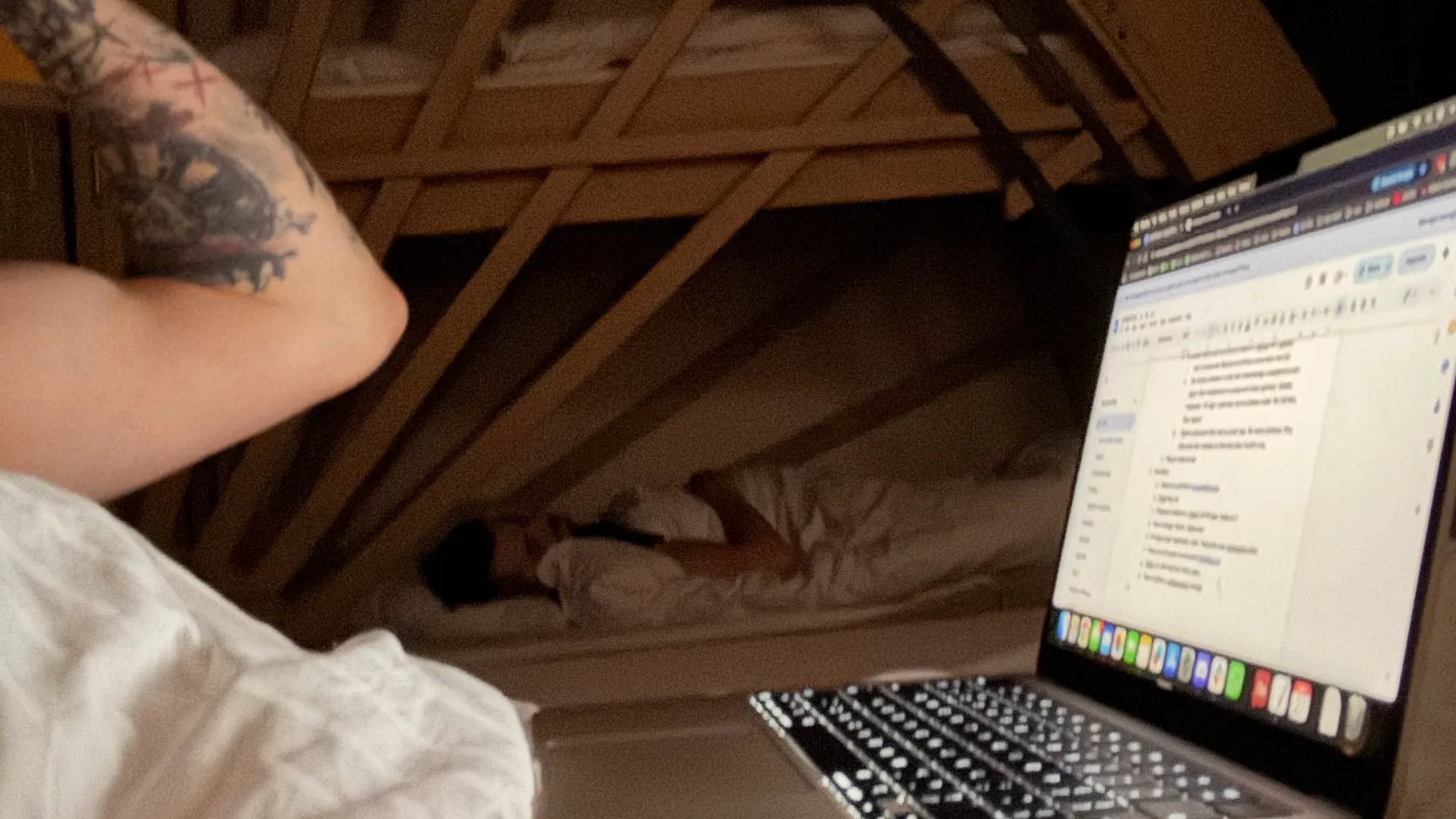
When I reached the point where I needed to put it on a server I was facing exactly this problem. Sure, everything is great if you’re building something internally or just for fun, but building a production-ready system is a much more serious thing. Sooner or later, this will break and I won’t even know how to fix it, not to mention security.
I had no intention (or skills) to use complicated self-hosting panels built for developers. At the same time, I had no intention of paying $20/month per project on popular PaaS platforms for a simple project that I open once a week.
And then it hit me: Wait, we have a control panel focused on simplicity that gives end-to-end project management, we have technology based on Docker… If only it supported more than just WordPress, in theory we would have a perfect solution!
So I called Paweł Kozioł, the lead developer of the project:
- “Paweł, can we make the Engine work for any project?”
- “What do you mean any project? What are you talking about?”
- Well, I built some project in Claude Code. Can our Engine host it?”
- silence… “OK, send it over and I’ll check.”
And just two weeks later, I had the first concept of the Engine supporting universal projects. I deployed my first application and… it worked!
That was the moment when it became clear to me: We need to pivot into this. PanelAlpha Engine is a technology that other people need at a huge scale, we just need to address it properly, adapt it to the market and promote the hell out of it.
What’s the plan for PanelAlpha?
The whole challenge in software in 2026 is not building. It’s marketing and distribution. That’s why since April (when I had this eureka moment), until the moment I’m publishing this post, our work has focused almost entirely on preparing PanelAlpha for much broader use and getting it ready to reach this new, much bigger market.
Our main mission is an extension of what we have been doing for the last few years: Create the SIMPLEST way to deploy and manage any project. No technical jargon, build a community and help with any problems to supports all the possible edge cases.
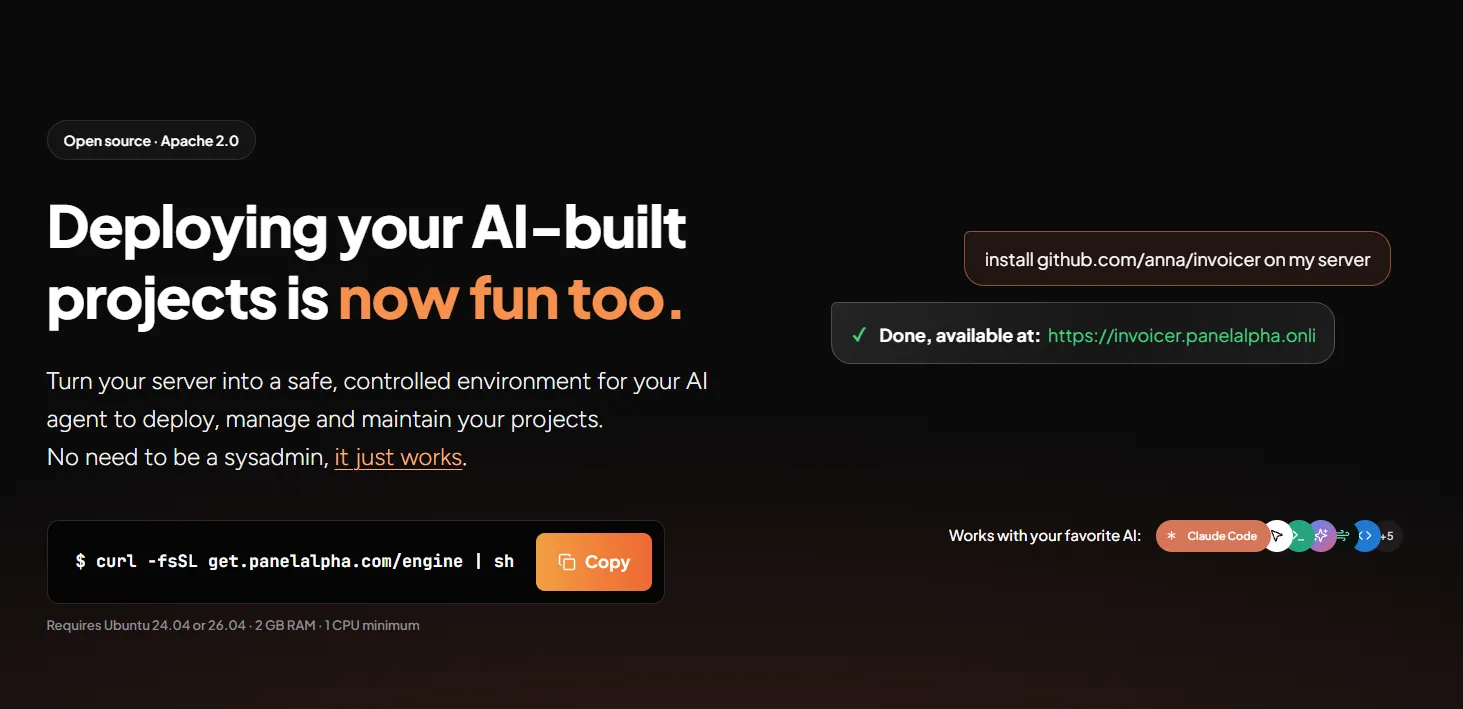
The next major step we are taking is releasing PanelAlpha Engine as Open Source. It will be an interesing solution itself, that you can hook up with AI to take over full control of deployments and apps management on your server. A safe, controlled environment for AI agentsm supporting ANY project, ready for production and professional use.
On one hand, this gives us another advantage in promoting it. On the other, it’s an invitation for the community to use it and help us develop it.
It is also meant to become the center of our offering and on its own, I believe it is a missing piece in the world of building projects with AI. It is the key to making servers simple for people who don’t want to become sysadmins.
Where’s the business in it?
So what about the panel and commercialization? Right now, honestly, I don’t know.
The market is still forming and at this stage it’s not yet clear where we should focus. I don’t want to make the same mistake as before and spend years focusing on a place where it simply isn’t worth it.
Quite the opposite. This time, we’re going as broad as possible. For the next 6-8 months, we will move fast with both product and marketing and try different directions. The technical team has been expanded and I, starting with this post, am taking over the marketing side and putting my full focus on promoting this technology.
With a product like this, we need to experiment with different value propositions for different groups of customers and different offers. Only after we find a model that scales will we narrow our focus and look for additional funding to scale it. I’ve secured funding for a year, which should be more than enough to find our growth vehicle.
Will it work? Hard to say. But we’re definitely in for an adventure!